
For decades, government agencies have operated with a straightforward communications model: publish accurate information on an official website, issue a press release when necessary, and trust that citizens, stakeholders, journalists, and industry will find what they need.
That approach is becoming increasingly outdated.
As artificial intelligence (AI) changes how people search for and consume information, agencies face a new challenge. Increasingly, people are no longer visiting government websites directly. They’re asking AI assistants questions and expecting immediate, synthesized answers.
The good news? Government agencies start with a significant advantage.
The challenge? They’re leaving that advantage largely untapped.
Government Is Well Positioned for AI Search
Large language models are designed to prioritize authoritative, trustworthy sources. Official government websites naturally fit that profile. Federal agencies generally publish information that is:
- Fact-based and well documented
- Regularly updated
- Transparent about sources
- Free from commercial incentives
As a result, AI systems frequently rely on agency websites when answering questions about regulations, scientific findings, public health guidance, grants, benefits, and countless other topics.
That means agencies are already influencing AI-generated answers, even if they never intended to.
But relying solely on official websites assumes that AI is only looking for pages, announcements, and documents. It isn’t.
AI Doesn’t Just Read Websites. It Understands Conversations.
Modern AI models increasingly evaluate information across an entire digital ecosystem.
Beyond official web pages, they mine information from:
- News coverage
- Expert commentary
- Industry publications
- Podcasts
- Videos
- Professional discussions
- Social media conversations
- Conference presentations
- Frequently asked questions
- Educational resources
These sources provide context that helps AI explain not just what an agency published, but why it matters, how people interpret it, and what questions people continue to ask.
If an agency limits itself to posting information on its website, it misses opportunities to shape that broader understanding.
The Cost of Staying Quiet
Many agencies still approach communications as a publication exercise rather than a conversation.
A new regulation goes live. A technical report is posted. Guidance is uploaded. Mission accomplished.
Except that’s rarely where public understanding begins.
Regulated industries, researchers, state and local governments, journalists, advocacy groups, and citizens immediately begin discussing what those documents mean. Those conversations happen on LinkedIn, YouTube, Reddit, trade publications, podcasts, association newsletters, webinars, and industry events.
If agencies aren’t participating in those conversations – or helping enable them – others will fill the void. Sometimes they’ll interpret the information correctly. Sometimes they won’t.
In either case, AI will increasingly encounter those discussions alongside the agency’s official publication.
The Solution Isn’t More Marketing
This doesn’t mean government agencies should become marketers. Their responsibility remains providing accurate, objective, nonpartisan information.
What they need is strategic public communication.
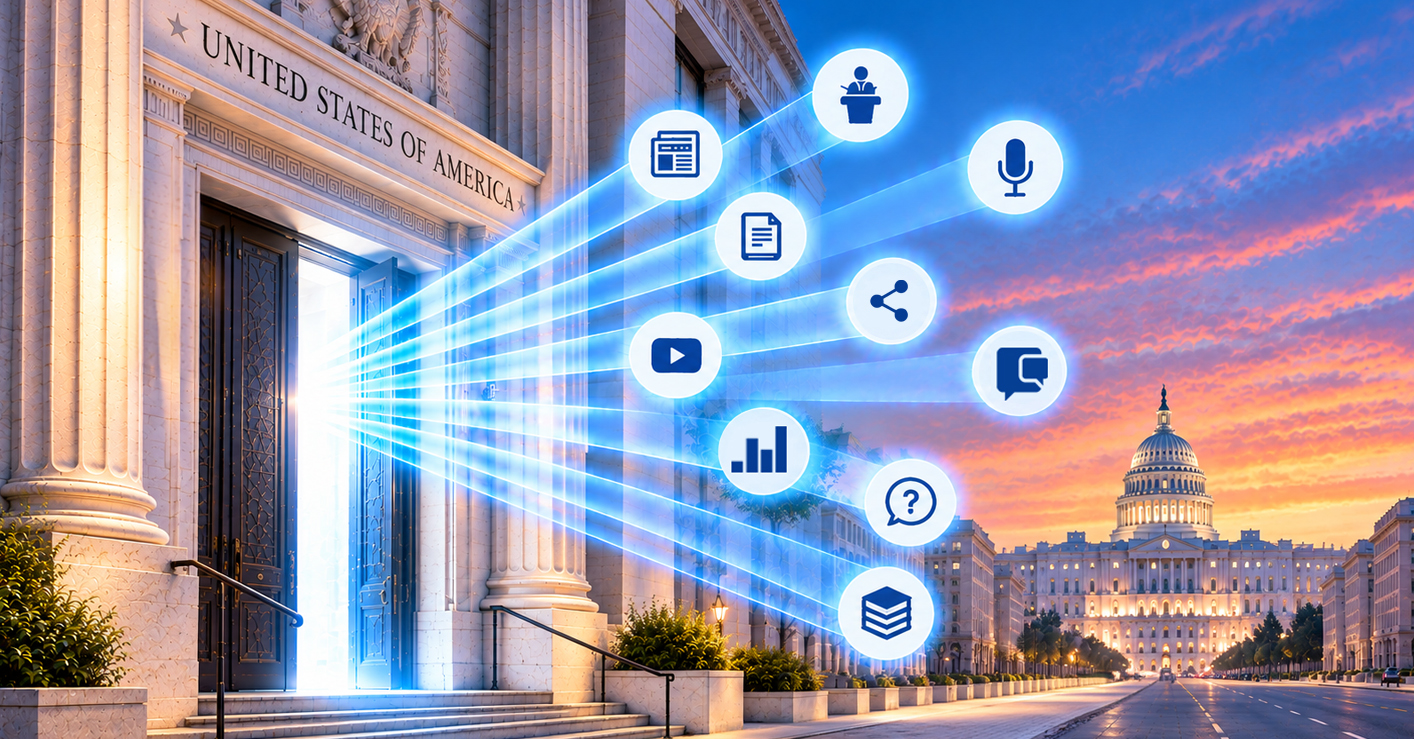
Agencies can responsibly expand their digital presence by creating content that helps audiences understand complex information, including:
- Short videos explaining new regulations
- Infographics that simplify complicated processes
- Frequently asked questions based on real stakeholder concerns
- Podcasts featuring program experts
- LinkedIn posts highlighting practical implications
- Webinars with technical specialists
- Plain-language explainers
- Shareable graphics for partner organizations
Each piece of content creates another authoritative signal that helps both people – and increasingly AI – understand the agency’s work.
Every Conversation Reinforces Accuracy
One of AI’s strengths is recognizing consistency across multiple credible sources.
Imagine an agency releases new cybersecurity guidance. Instead of only publishing a PDF and news release or announcement, the agency also produces:
- A technical blog explaining the rationale
- An expert interview discussing implementation
- Social media posts answering common questions
- A webinar with agency specialists
- Graphics summarizing key recommendations
- Articles in relevant trade publications
- Media interviews with subject matter experts
Now the same authoritative message exists in multiple formats, reaches multiple audiences, and becomes part of the broader public conversation.
When AI later answers questions about that guidance, it has substantially more high-quality context available.
The result is greater visibility and, equally important, greater accuracy.
Government Has an Untapped Advantage
Unlike many organizations competing for visibility online, federal agencies start with assumed credibility. But they struggle with amplification.
Many agencies produce exceptional research, groundbreaking science, innovative technology, and policies that affect millions of Americans. Yet much of that work remains confined to lengthy reports or webpages that relatively few people read.
AI creates an opportunity to extend the reach of that information, but only if agencies provide enough supporting content for both people and AI systems to understand its substance and significance.
Communications Strategy Is Now Information Strategy
As AI becomes the first stop for answering questions, agencies should think beyond publishing documents and announcements.
The question needs to shift from, “Did we post it?” to, “Did we create enough authoritative context for people – and AI – to discover and accurately understand it?”
The agencies that succeed in this new environment won’t necessarily publish more information. They’ll adopt the proven content strategy of “create once, distribute everywhere.” That means publishing smarter, creating and producing richer educational content, and participating in broader professional conversations – extending and ensuring their expertise extends far beyond the boundaries of their websites.
In an increasingly AI-driven world, agencies that shape the conversation will be better positioned to ensure accurate information reaches the public. Those that rely solely on people finding a webpage may discover that being authoritative is no longer enough.
Authoritative information still matters. But increasingly, authoritative conversations matter just as much.
Is your agency preparing for the future of search? Discover how Spire helps federal agencies increase visibility, reach, and engagement.