


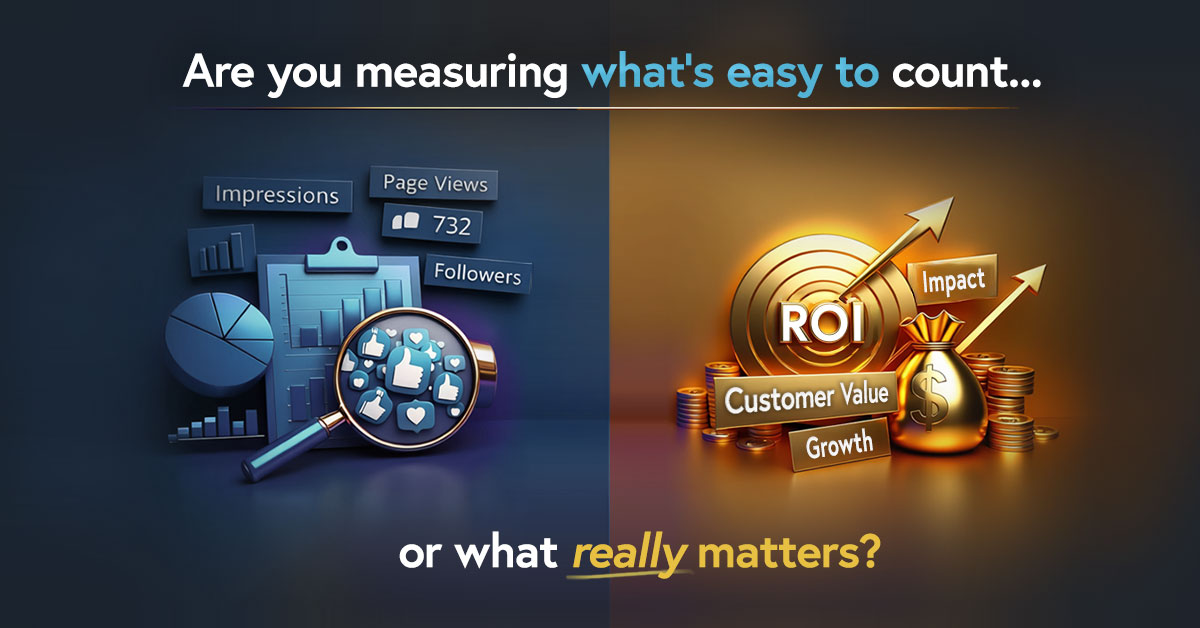
Impressions. Conversions. Open rate. Engagement. Bounce rate.
There are a lot of buzzwords floating around regarding analytics for your communications strategy. So how do you know if your branding and messaging – let alone marketing campaigns – are actually working?
Metrics alone, unfortunately, don’t tell a whole story. Numbers rarely speak for themselves.
To evaluate success, you need to know what to measure. Do you want to know how many social media posts your organization made last week? Or how many likes each post got? Or if the post with photos of staff at a conference got the most clicks through to your website?
The distinction is important – and asking for “social media metrics” without clarifying what you’re truly looking to learn won’t get you very far.
Take a step back
To identify the right metrics to track, first establish clear communication goals. A solid communications strategy outlines what you’re looking to achieve, as well as the appropriate tactics to get there. Only then can you define metrics that will tell you whether those tactics are working.
Let’s continue with the social media example. If your goal is to boost event registration for an upcoming conference, advertising the event on social is one viable tactic. The appropriate metric isn’t the number of social posts (though more posts might make for stronger execution on that tactic). Rather, the critical metric is the number of registrants – a value most likely captured in a different system, not through social channels.
This is what’s tricky about metrics. It’s easy to pull numbers like reshares or pageviews, but they might not tell you much about your audiences or the behaviors you want to drive. To get useful insights, you’ll need to drill deeper to connect social clicks to event registrations.
The same thing applies to media relations. In addition to tallying the number of articles published about your organization in major trade outlets, it’s important to track sentiment and pull-through of your main messaging.
And remember: Sometimes, a small numerical value is evidence of an effective strategy if you’ve reached your intended target.
Making sense of metrics
Once you’ve defined the metrics that will measure success against goals, the next steps are reporting and interpretation.
Data visualizations provide meaningful context for what would otherwise just be stand-alone numbers. A baseline comparison will reveal whether tactics are performing better or worse over time – a point of particular importance when implementing major changes in your communications strategy.
The best web and social platforms (such as Google Analytics and Hootsuite) come with integrated dashboards and automated reporting. However, you may find it valuable to augment these tools with a tailored spreadsheet or a dashboard that consolidates analytics across tools (more news from Spire on this front in the future!). At a minimum, a graph with a trendline over time provides a quick glance verification of how your tactics are performing. For more comprehensive or formal reports, a well-designed infographic can help tell the full story of your communications team’s activities and impact.
However the metrics are displayed, they’ll also need an accompanying interpretation. Here’s where industry averages and definitions become valuable. The meaning of “likes,” “impressions,” “views,” “active users,” and “engagement rate” can vary by the platform, so it’s important to include those definitions with any report. (Remember, more “likes” doesn’t necessarily mean you’re tracking towards your goal.)
Other considerations that affect the interpretation of metrics include:
- Time range (such as month-over-month growth)
- Industry averages to benchmark against (especially if there isn’t an established internal baseline)
- Any unusual circumstances (like a prolonged government shutdown or other pause in communications)
With effective reporting and interpretation, agency leaders will be able to understand how individual metrics track the effectiveness of tactics and, collectively, how they contribute to communications goals – such as a highly engaged audience, a positive reputation, and the organization’s overall mission.
Putting results into practice
All too often, fancy reports with lots of numbers become conflated with the true purpose of your communications metrics program. If the numbers alone replace the real goal, the strategy could stall.
To avoid that outcome, it’s vital that your communications team take the final step in the metrics journey: Using the insights to adjust future tactics and strategies. For example, if your eye-tracking tool shows that viewers are leaving your website at a specific point on the page, are you adjusting your page content to encourage people to keep reading?
Data-driven decisions ensure that your team does more of what works and less of what doesn’t. Metrics demonstrate their merit when they reinforce a cycle of continuous improvement, agility, and alignment with organizational objectives.
Need help with communications metrics? Spire experts can help mine the meaning in your analytics to inform a holistic strategy that engages your ideal audience. Contact us to get started.